Tell us about the school
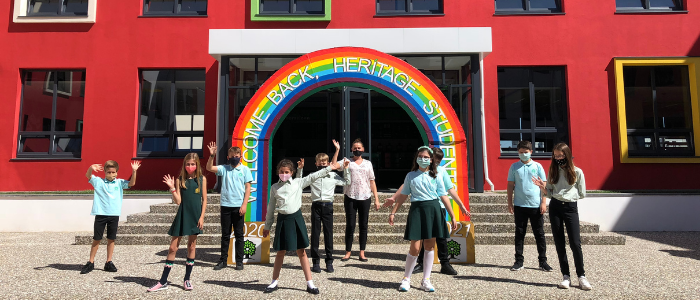
Heritage International School was established in 2017 as the first truly international school in Moldova. Its founders wanted to establish an outward-facing school that would develop internationally-minded citizens who would become leaders in their societies in Moldova and elsewhere. The school has a modern campus, based on an all-through school system. The official language we use is English, but we also teach in Romanian and Russian.
The school serves both the local and international communities and we offer the national and Cambridge curricula. In the Gymnasium (lower-secondary school), the vast majority of students have opted for Cambridge and iGCSEs and our Lyceum (upper-secondary), offers only Cambridge, to give learners access to universities in Moldova and around the world.
We are also firm believers in innovation and connecting classrooms, so we use digital tools to bring the world into our classrooms. Global Perspectives is a very popular part of our curriculum because students are passionate about making the UN Sustainable Development Goals a reality. We regularly invite speakers from all walks of life to give lectures that allow our students to develop their critical thinking skills. We also have a very strong sense of social responsibility, supporting our local community.
When the pandemic struck, how did you develop your distance-learning plan? What did you learn as you did so?
We developed our distance learning plan in early March after I returned from an international schools conference in Egypt. While I was there, I met people from many other international schools, who were already experiencing the first Covid wave and implementing distance learning. Over cups of tea in Cairo, I was fortunate enough to be told what had worked and what had not. As the pandemic continued to spread, I realised that doing nothing couldn’t be an option. Students needed learning, routines, familiarity and above all hope.
As soon as I got back, we started work on preparing. Luckily, we had already done a lot of previous work on online safety, and had a robust school policy in place.
When the full lockdown order came, we knew this would be for at least three months until the end of the academic year. The school community was brilliant from the start. Everyone wanted this to work and the trust and confidence from our school community meant everything. I was very proud of all my colleagues, knowing that they were in their apartments, teaching from their kitchens, with their own children around them.
We kept the “spine” of the school routine, to keep us all together, including weekly online meetings, briefings, teaching and learning briefings, assemblies and our newsletter. Within a week, it was as if we had been doing this for a long time as our “new normal” was underway. What has really stood out throughout this crisis is the way school communities and educators have become so adaptable at all the changes and disruption thrown at them.
How did you come to the attention of the Moldovan education minister?
Heritage’s head of global learning, Tatiana Popa, called me one Saturday, soon after we had started the distance learning plan. She said the state secretary of the ministry of education wanted to see us urgently at school to talk about what we were doing. We had been all over the national media that week as the only school that had moved immediately to online lessons.
The state secretary not only turned up with her team, but the minister himself, Mr Popivici. This was a huge surprise and not a normal Saturday afternoon! We all sat in my office, but my poor grasp of Romanian meant that my colleagues had to do most of the talking. So I did the most useful thing I could think of – the British thing – and made everyone tea with milk!
We spoke about how children needed routines and how this model was not dependent on having the most sophisticated digital learning platforms.
For the minister and his team, this really was about helping local communities find a local solution to fit their context.
Our model was going to be the basis for the country’s policy, as the government moved to enable distance learning. We all understood how crucial collaboration was to allow Moldova’s children to have access to education, and teachers to work and still collect salaries. We finished the day repeating “doing nothing was not an option”.
One of my colleagues immediately joined the ministry task force and was responsible for the online safety policy. Tatiana made webinars and went onto train thousands of teachers in how to operate a distance learning plan. The national plan gained its own momentum as NGOs such as UNICEF and UNDP supported the provision of hardware in schools and Orange Moldova made free internet access available to teachers.
We continued to speak online to colleagues and also weekly to international schools from different countries. One of the best things to have emerged from this crisis it is a sense of collaboration in international education.
How has this supported or raised the profile of international education in the country?
We worked with the British Council to put on a huge global online event in July, “Getting back to Global” with brilliant global educators speaking. We had over 10,000 people watch and it was such a positive event to emphasise the good that has come from the crisis. The ministry has made steps towards recognising international qualifications in Moldova, which is a good sign.
Are there any practices or approaches that you see being applied long term in Moldova?
For the new academic year, we were able to return to the classroom. We worked with our key partners in the WHO and UNICEF, as well as our global networks, to have a strategy that managed the return, and introduced hybrid learning. Four weeks in, we are constantly adjusting and adapting, but everyone is committed to making it work.
Do you think the school closures will have a lasting impact on education?
The longer it lasts, the more issues we see coming from this, not least the daily disruption and uncertainty in every school that is trying to operate and model normality.
The late Sir Ken Robinson spoke about the opportunity to reimagine curriculum when the biggest global crisis of the 21st century has challenged the best scientific and political minds to find solutions. John Hattie talks about this being the “golden ticket” and an accelerator of change in how digital capabilities can transform the ways we learn, the role of the teacher and the very notion of physical school. UNICEF and the OECD have highlighted the devastation having no access to education is causing. Those students with the least resources will get further behind and be unable to access the global economy and society.
Communities have been finding just how resourceful they truly are, and how adaptable we can really be to ensure we continue the learning process for young people.
Covid hasn’t gone away, and it won’t any time soon. Distance learning plans have become hybrid learning plans when students or classes are sent home for 14 days. No organisation can be entirely “Covid secure” until there is a vaccine. We can only mitigate without a vaccine, but changing our behaviour can help. Getting used to the ping pong effect of isolation, physical school and the energy needed to keep it all together, will be the story of 2020-21 as school leaders try to look ahead to a life after Covid.
By blog.cambridgeinternational.org